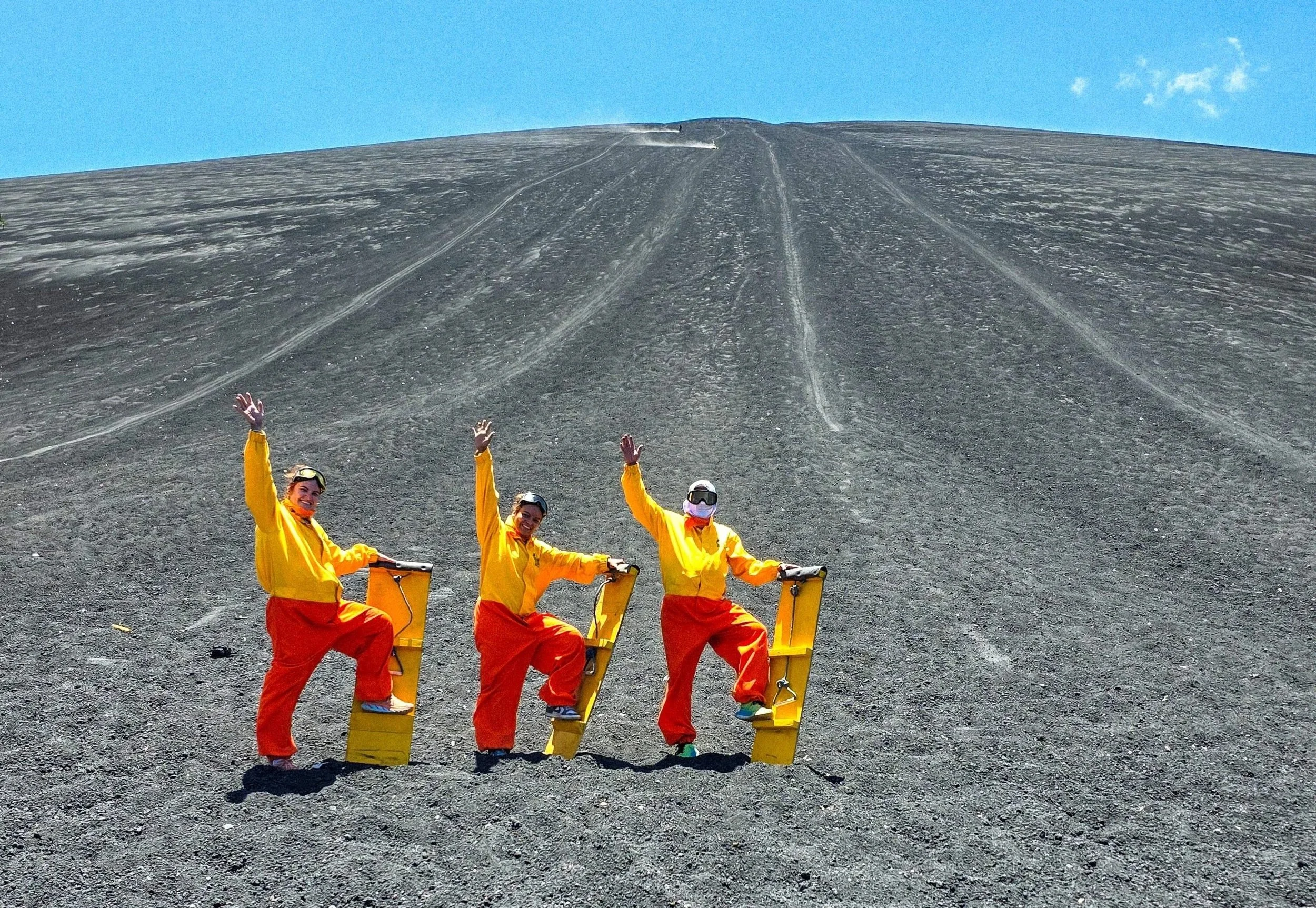
What Is Volcano Boarding Really Like?
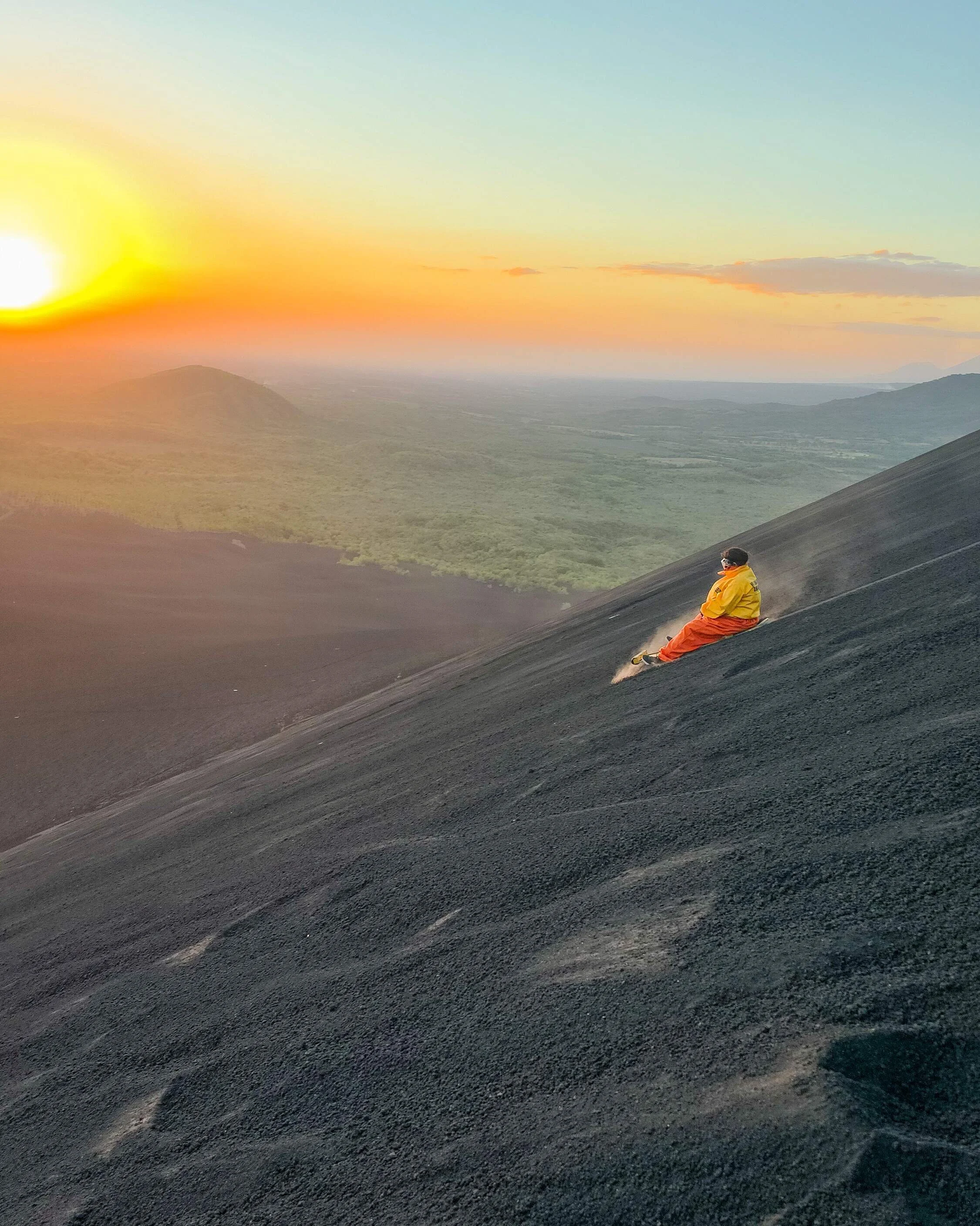
A First-Timer’s Guide to Cerro Negro
How scary is it? Can you slow down? What if you fall? Do you need experience? And what does sliding down a volcano actually feel like?
You’ve seen the photos.
Someone dressed in protective gear, sitting on a wooden board, flying down the black side of a volcano in Nicaragua.
It looks incredible.
It also raises a few questions.
If you’re thinking about volcano boarding at Cerro Negro near León, here’s what your first experience is really like—from the climb to that moment at the top when you look down and realize you actually have to get back down somehow.
First: What Exactly Is Volcano Boarding?
Volcano boarding is exactly what it sounds like.
You climb a volcano and descend part of its loose volcanic slope on a specially designed board.
The experience takes place at Cerro Negro, outside León in western Nicaragua. Its stark black slopes make it one of the most recognizable landscapes in the region.
Most people descend sitting on their board with their legs in front of them rather than standing snowboard-style.
And you don't need previous experience.
For most travelers, their first time volcano boarding is exactly that—their first time.
But before the ride comes the climb.
You Have to Climb the Volcano First
There is no chairlift at Cerro Negro.
You earn the ride down.
Compared with many of Nicaragua's other volcano hikes, Cerro Negro is relatively short, making it an accessible introduction to volcano hiking for many travelers.
You'll climb through increasingly dramatic volcanic terrain while carrying your board.
And this part shouldn't be treated simply as something you have to endure before boarding.
Look around.
The contrast is extraordinary.
Cerro Negro's dark volcanic landscape sits against green countryside, distant mountains and other volcanoes stretching across western Nicaragua.
As you climb, the views keep getting bigger.
Eventually, you reach the top.
That's when things get interesting.
Then You Look Down
This may be the most memorable moment of the entire experience.
You've spent the hike thinking about volcano boarding.
Now you're standing at the top looking at the slope you're actually going to descend.
It looks different from up there.
Usually steeper.
You may watch someone else disappear down the black slope before it's your turn.
Some people immediately want to go.
Some suddenly become very interested in asking their guide a few more questions.
Both are normal.
Before anyone descends, your guide explains how to position yourself, how to manage your speed and what to do during the ride.
Listen.
This is one time when pretending you already know what you're doing isn't particularly useful.
What Does Volcano Boarding Actually Feel Like?
It's difficult to compare it to anything else.
The board begins moving over loose volcanic material. You hear volcanic gravel hitting the board and your protective clothing. The landscape starts moving past you considerably faster than it did on the hike up.
And then you realize:
You're boarding down a volcano.
The ride can feel fast and surprisingly loud.
Some people immediately want more speed.
Others are perfectly happy taking a more controlled descent.
There's no prize for being the fastest person on Cerro Negro.
The goal is to experience it.
Is Volcano Boarding Scary?
For some people, yes.
Particularly when you're standing at the top.
But being nervous doesn't mean you shouldn't do it.
You don't need to arrive fearless, and volcano boarding isn't reserved for extreme-sports athletes.
A little nervousness is part of what makes an adventure feel like an adventure.
Tell your guide if you're uncomfortable. Pay attention to the instructions. Don't worry about what the person next to you is doing.
Your experience doesn't need to look exactly like theirs.
Can You Control Your Speed?
You have some ability to influence your descent using the technique your guide shows you, including your riding position and feet.
But you're still descending a natural volcanic slope covered in loose material.
This isn't a theme-park ride running on rails.
Conditions can vary, which is one reason listening to your guide matters.
If speed is making you nervous, say so before you start .
You don't need to race anyone.
What if you fall?
It can happen, but likely not.
You're participating in an outdoor adventure on loose volcanic terrain, so nobody should promise that every descent will be perfectly smooth.
That's also why protective equipment, proper instruction and following your guide matter.
If something doesn't feel right before you descend, ask.
There is absolutely no benefit to pretending you're comfortable when you're not.
Does Volcano Boarding Hurt?
The objective isn't for it to hurt.
You will be wearing protective equipment, but that doesn't change the fact that you're moving across real volcanic terrain.
Expect bumps and vibration through the board. Expect volcanic material to hit your protective clothing.
As with any adventure activity, volcano boarding involves risk. Using the equipment properly, listening to your guide and riding within your comfort level are important parts of the experience.
How Dirty Will You Get?
Let's answer this one clearly.
Very.
You WILL get dirty.
Cerro Negro's fine black volcanic material has an impressive ability to get everywhere.
Protective clothing helps enormously.
It does not create an invisible volcanic-dust force field.
Wear closed-toe shoes and clothing you don't mind getting dusty underneath your protective gear.
You'll clean up.
The photos are worth it.
Do You Need To Be Fit?
The boarding isn't the physically demanding part.
Getting yourself to the top is.
Cerro Negro is a relatively short volcano climb, but you're still hiking outdoors in Nicaragua, potentially in heat and strong sun, while carrying your board.
Take your time.
Bring plenty of water—too much is better than not enough.
And don't compare your pace with everyone else's.
If you're trying to determine which Nicaragua volcano matches your fitness level, our How Difficult Are Nicaragua's Volcano Hikes? guide compares Cerro Negro with Telica, El Hoyo, Cosigüina, San Cristóbal and Momotombo.
Can Beginners Use a Volcano Board?
Yes.
You don't need snowboarding, skateboarding or surfing experience to try volcano boarding.
Most first-time visitors have never done anything quite like it before.
Your guide explains the technique before the descent.
Your job is to pay attention.
What Should You Wear?
Keep it simple.
Wear closed-toe shoes with good grip and lightweight, comfortable clothing suitable for Nicaragua's climate.
Bring sun protection.
Bring plenty of water.
And don't wear anything underneath your protective gear that you're terrified of getting dirty.
Specialized volcano-boarding and protective equipment is provided on Volcano Life's boarding experiences.
For everything else, see our What to Pack for a Volcano Hike in Nicaragua guide.
The Questions Everyone Has Before Volcano Boarding
There are some questions people don't always ask until they're already standing on Cerro Negro.
Do I have to race?
No.
This is your experience, not a competition.
Can I go slower than everyone else?
You don't need to match someone else's speed. Listen to your guide's instructions about managing your descent and tell them if speed is something you're concerned about.
What if I'm nervous at the top?
Tell your guide.
Being nervous when you look down a volcanic slope you're about to board is hardly unusual.
What if I'm afraid of heights?
Cerro Negro may feel intimidating if heights or steep slopes make you uncomfortable. Talk to your guide before the descent rather than keeping it to yourself.
Can I change my mind?
If you're genuinely uncomfortable participating, communicate that to your guide. Nobody benefits from forcing an adventure you're not comfortable doing.
Can I bring my phone or camera down?
This is something to discuss with your guide on the day. Following boarding instructions is more important than getting footage during your descent. The volcanic dust is hard on glass and equipment. A good case would be a must.
And remember: sometimes the best photo is the one someone else takes of you .
Sunrise, Daytime or Sunset?
When you go it can change the experience considerably.
A sunrise adventure means an early start, cooler conditions and watching the landscape change as Nicaragua wakes up.
A daytime experience works well for travelers building Cerro Negro into a larger itinerary.
And sunset brings completely different light to the volcanic landscape.
Volcano Life's Sunset Volcano Boarding experience also includes a high energy return to León, making the journey back part of the experience.
If you're deciding between different times of day, our Sunrise vs Sunset Volcano Tours guide goes into more detail.
What Happens When You Reach the Bottom?
There's usually a moment when you turn around and look back up.
You just came down that .
And somehow it looks bigger from the bottom.
You'll regroup, deal with the inevitable volcanic dust in your shoes, and have a chance to enjoy what you just did.
But your adventure doesn't necessarily have to end at Cerro Negro.
Volcano Life offers experiences that combine volcano boarding with other parts of the León region, including Lake Asososca, Isla Juan Venado, horseback riding, mountain biking and the Pacific coast .
You can climb a volcano in the morning and end your day beside the ocean.
That's one of the things we love about León.
So... Is Volcano Boarding Worth It?
If you've traveled all the way to Nicaragua and you're wondering whether volcano boarding is just a tourist gimmick, consider what you're actually doing.
You're hiking through an extraordinary volcanic landscape.
You're standing on Cerro Negro looking across western Nicaragua.
And instead of simply walking back down...
you're boarding down the side of the volcano.
It's weird.
It's dusty.
It can be intimidating.
And that's exactly why people remember it.
You don't need to be fearless.
You don't need to be the fastest.
You don't even need to look particularly graceful doing it.
You just need to be willing to climb up and give it a try.
Your First Volcano Boarding Adventure with Volcano Life
Volcano Life officially opens in León on November 1, 2026.
Our Cerro Negro experiences include transportation from León, guides, volcano boards and protective equipment, with several ways to build the experience into your Nicaragua itinerary.
Choose sunrise.
Make Cerro Negro part of your day.
Come for sunset and ride the adrenaline back to León.
Or combine volcano boarding with another adventure and experience even more of this part of Nicaragua.
Whichever you choose, there's one thing we can confidently tell you:
You WILL get dirty.
And you'll probably have a pretty good story afterwards.
Nicaragua — León Style. 🌋